There's a bit of magic being performed upon Myanmar's movie theaters these days. A celestial twist of collective fate that has been working its way from town to charm-stuffed town across the country. The magic is that for the past couple of years a good number of theaters have been ushered out of purgatory, and the eventual rubble heap, through the shimmering gates of salvation. That's right, old movie theaters throughout Myanmar are being renovated at a fairly high rate. The lone down side is that for this new generation of theater renovators, the
shimmering part is literal. Crimes against architecture are being perpetrated one cheap, shiny piece of vinyl at a time.
Take, for instance, the
Kithi Cinema; a classic Tropical Art Deco theater right in the heart of Mogok. The
Kithi was contracted at the height of Myanmar's movie theater construction boom, which followed independence from Great Britain in 1947. In the years to follow, Tropical Art Deco came into vogue among the country's builders and architects. As the style proliferated, many of its finest examples found expression in the form of movie theaters, matching these iconic cultural venues with the most lavish architectural trend of the era.
In a shining sign of these current times, however, some of Myanmar's nascent theater renovators seem to have little regard for yesterday's design sensibilities. Case in point, the Tropical Art Deco facade of the
Kithi has been completely covered up with uninspired, vinyl paneling. It's a bittersweet outcome for an otherwise positive development. Getting a reactivated original movie hall - with all it's crowd-drawing potential and landmark status right in the center of a historic town - is a good thing. Getting mutilated architecture in the process is bad. The most unfortunate part is that it's completely unnecessary.
The original Tropical Art Deco crest of the facade of the Kithi Cinema peaks out from behind the hideous vinyl paneling
Beast kills beauty.
From this angle, a corner of an adjacent building is visible in the foreground. Though in dire need of some sprucing up, this is the type of simple, but elegant architecture that much of Mogok - and Myanmar cities in general - is comprised of. The the same type of architecture that has been needlessly obscured in the Kithi Cinema.
When modernizing old movie theaters it's not uncommon for the theater's functional components to be completely replaced. Take seating, for example. Before renovations, the
Kithi was making use of its original teakwood seats. While beautiful in their own right, hard wood seats do not sit well (no pun intended) with 21st century audiences. The newly installed cushioned seats, on the other hand, mark a technological upgrade that will make watching movies more comfortable. As will the new and improved sound system and digital projection. With such improvements, a bit of provenance is sacrificed for an enhanced user experience. But unlike the functional aspects of movie theaters - seats, the screen, audio and projection - the facade is strictly ornamental and should be restored to its original look.

The Kithi's grand auditorium has been completely gutted and modernized. A section of it has been cut away to make room for a second, mini-auditorium, so that the theater can screen two films at the same time. Overhauling a square box auditorium to improve the movie-watching experience is acceptable so long as no rare architectural elements are removed. Obliterating an original facade is unacceptable.
A smaller, secondary auditorium has been cut from the original.
Galaxy Cinemas, the company behind the revival of the
Kithi, is attempting to brand itself with a distinct visual identity. All of their theaters feature the same boxy facade of red and silver, whether built from the ground up or from existing movie theaters that they renovate. Ostensibly, their design concept is riding the wave of the current building boom that is making its mark on many parts of the country. As such, the upstart company is attempting to make themselves appear sleek and new.
As important as brand identity is, it's a poor excuse for covering up good architecture. Galaxy could have achieved the same visual branding simply by tidying up the original tropical Art Deco facade. The company logo, moreover, placed in a suitable spot on the old facade, would have served as a fine branding marker, without dishonoring the architecture and the theater's long history. This is a conceptual error that I see being corrected, at great expense, years later all over the west.
Oddly enough, the lobby area, including a pair of beautifully crafted teak stairs, wooden poster cases and wood paneled ticket booths, have been painstaking restored to their original mid-century look. If the same attention had been paid to the facade, this would count as a stellar renovation job.
Restored poster display case and stairs in the lobby if the Kithi Cinema.
Had I arrived in Mogok just a month or so earlier I would have been able to document the
Kithi in its original Tropical Art Deco guise. Thanks to the power of the internet, I was able to track down an image of it pre-mutilation courtesy of photographer Jamie Johnstone.
Click here to view the photo.
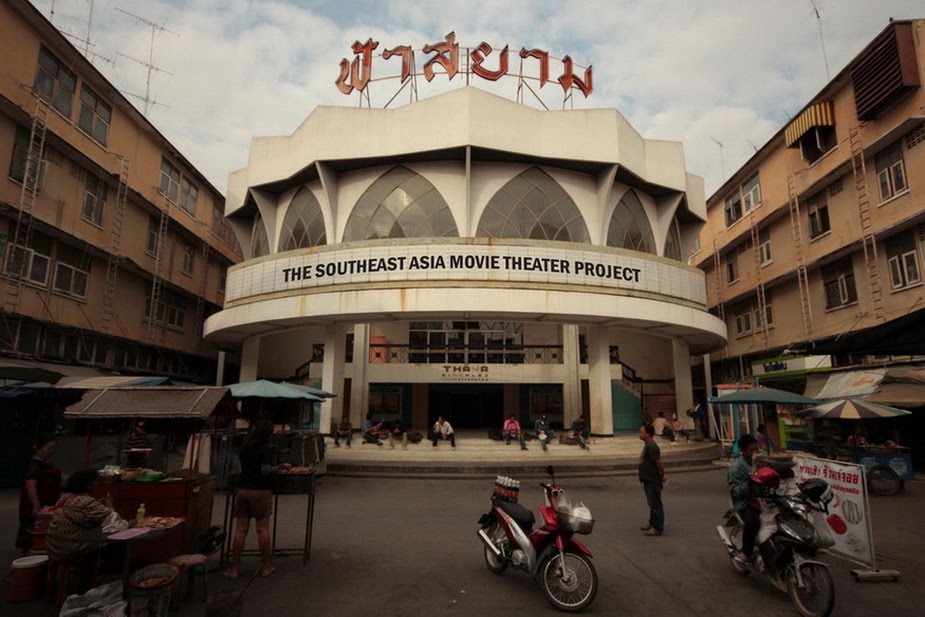
Below is a sample of other Tropical Art Deco movie theaters I've had the good fortune to document throughout Myanmar.
The Yuzana Cinema - Pyin Oo Lwin
The Myoma Cinema - Pyin Oo Lwin
The Aung Tha Pyae Cinema - Yemathin
The Aung Mingala Cinema - Dawei
The Win Cinema - Toungoo
The Aung Theit Thi Cinema - Myaungmya
The Hla Thiri Cinema - Minbu
The Kemarat Cinema - Keng Tung
The Thwin Cinema - Yangon